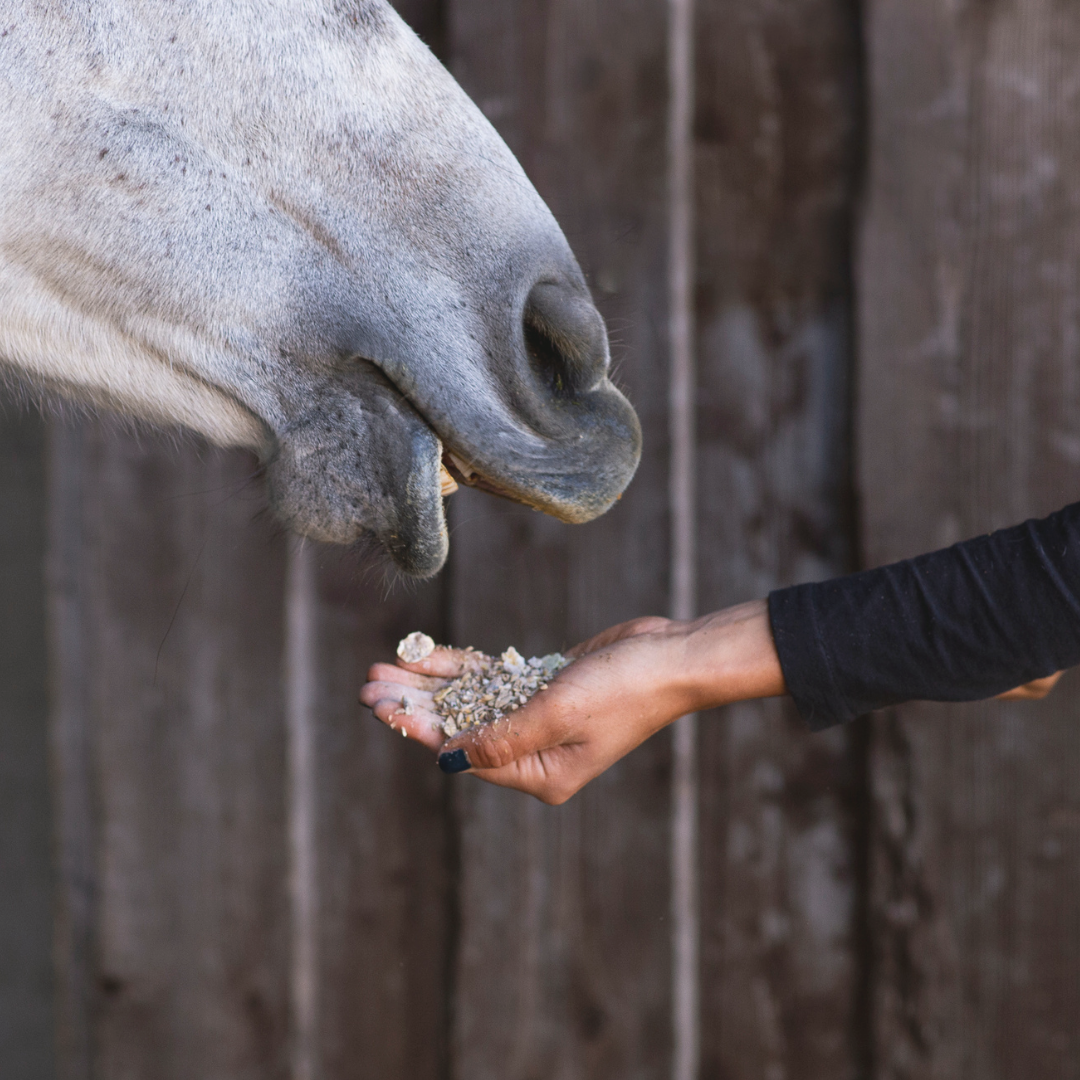

Horse Gut Health: Removing the Limits You Can't See

A horse who will not settle at the mounting block. One who spooks at the same corner every single ride. One who carries plenty of weight and still has nothing over his topline. I get asked about those horses constantly, and the question almost always starts with the behavior. Horse gut health sits much further down the list of suspects than it should.
Here is the short version. A horse shows you who he really is only when nothing inside him is competing for his attention. When digestion is unsettled or the diet is out of balance, the horse you meet is a compromise rather than the animal himself. A lot of what we file under temperament is a signal, and signals can be read.
These limitations do not start in the saddle. They start inside the horse.
KEY TAKEAWAYS
- Gut function shapes nutrient absorption, immune response, inflammation, and mood, so it shapes behavior too.
- The three most common gaps in an otherwise reasonable program are forage quality, amino acid balance, and trace mineral and vitamin coverage.
- A horse can be overweight and still deficient. Calories and balance are separate questions.
- "That's just him" and "that's the breed" are worth challenging before you accept them.
- Start with a forage analysis and an honest read of the horse, not with another supplement.
WHAT IT MEANS FOR A HORSE TO BE HIS TRUE SELF
I am talking about three specific things: movement that looks natural for that horse, a mind that settles, and energy that holds steady instead of spiking and crashing.
Most horses are running below that line, and the gap rarely announces itself clearly. It shows up as a horse who warms up slower than he used to, or who has become mildly unpleasant to girth, or who is fine but has not been good in a while. Nothing about that is dramatic enough to call a vet. That is exactly why it persists.
A hidden limitation is any physical, metabolic, or behavioral constraint that has become normal enough that nobody questions it anymore.

THE GUT IS THE CONTROL CENTER
The equine digestive tract is not just a not a pipe that food moves through. It is where nutrients are broken down and absorbed, where a large share of immune activity happens, and where the microbial population that ferments forage lives. When that population is unsettled, the horse is restricted from the inside out, and none of it is visible from the outside.
Signs the gut may be limiting your horse:
- Energy that swings instead of holding steady through a ride
- Sensitivity to grooming, girthing, or leg pressure that is new for him
- Stiffness or a recovery period that keeps getting longer
- A dull coat, or a topline that will not fill no matter what you feed
- Picky eating, or a horse who looks bloated after meals
One of these on its own is worth noting. Three of them together is a pattern, and patterns are worth investigating before you decide the horse is just difficult.

THREE PLACES GOOD PROGRAMS STILL FALL SHORT
Most of the diets I look at were built with care. The gaps are rarely careless. They are usually in the places that are hardest to see without testing.
Forage First
Forage is the foundation, and it is also the piece we assess the least. Most horses should be eating 1.5 to 2 percent of their body weight in forage daily, which is 15 to 20 pounds for a 1,000 pound horse, and the nutrient content of that forage varies enormously with species, cutting, maturity at harvest, and storage.
A hay analysis typically runs $25 to $60 per sample and tells you protein, fiber, non structural carbohydrates, and mineral content. Without it, every decision downstream is a guess. Poor forage creates more digestive and metabolic stress, and it leaves bigger gaps in the rest of the program than most owners expect.
Amino Acid Balance
Crude protein percentage on a feed tag tells you how much protein is present, not how usable it is. What matters is the amino acid profile, and specifically lysine, methionine, and threonine. Those are the first three limiting amino acids. If you do not meet them, nothing else in the diet fills to capacity, no matter how much of it you feed.
This is why a horse can eat well and still fail to build a topline. He is not short on feed. He is short on the specific building blocks that muscle requires. The National Research Council's Nutrient Requirements of Horses puts lysine requirements for a 500 kilogram horse at maintenance near 27 grams per day, and that requirement climbs with work.
Trace Minerals and Vitamins
Copper, zinc, magnesium, selenium, and vitamin E are where the invisible limitations tend to live. Deficiencies here show up in hoof quality, joint comfort, muscle recovery, and mood, none of which the owner connects back to a mineral.
Vitamin E is the clearest example. Fresh growing pasture is the primary natural source, and levels drop substantially once forage is cut and cured, then continue dropping in storage. A horse on hay alone through a long winter is the standard case for supplementation, and blood testing through your veterinarian tells you where he actually stands before you start adding.
This is also where the "fat but deficient" horse comes from. Calories and nutrient balance are two separate accounts. A horse can be overweight on empty calories and short on the nutrients that let him use them.

HOW TO FIND THE ACTUAL LIMITATION
Four steps, in this order. The order matters, because each one narrows what the next one has to consider.
- Test the forage. Pull a core sample of the hay you are actually feeding and send it in. Everything else is built on this number.
- Read the horse honestly. Body condition score, muscle mapping along the topline and hindquarters, coat, hooves, and manure consistency. Photograph him from the same angles every 30 days, because change this slow is invisible day to day.
- Question the labels. "That's just him." "That's the breed." "He's always been spooky." Every one of those is a conclusion somebody reached once and nobody revisited. Take one of them and treat it as a question instead.
- Ask whose convenience the program serves. Most feeding plans get built around the barn schedule, the boarding arrangement, and the owner's drive time. Those are real constraints and they are not wrong. But it is worth asking, once a year, whether the plan fits the horse or fits your life. Usually there is a version that does both, and nobody has gone looking for it.
Then change one thing at a time and give it 30 to 60 days. If you change four things and the horse improves, you have learned nothing you can use on the next horse.
WHAT CHANGES WHEN THE LIMITATION COMES OFF
I want to be careful here, because this is where equine nutrition gets oversold. Nutrition does not fix a training problem, a saddle fit problem, or pain with an orthopedic cause. What it does is remove the constraints that were making everything else harder.
When the diet actually matches the horse's biology, what tends to return is movement that looks looser and more willing, focus that holds instead of scattering, and energy that stays level across the week. Owners usually describe it the same way: he seems more like himself.
That is the whole point. You are not building a different horse. You are getting out of the way of the one you have.
FREQUENTLY ASKED QUESTIONS
Can nutrition really change my horse's behavior? It can change behavior that has a nutritional cause. Discomfort, unstable energy, and certain deficiencies all show up as reactivity, dullness, or resistance. Nutrition will not resolve behavior rooted in training gaps, pain, or fear. The useful question is whether you have ruled nutrition out, not whether it explains everything.
How long before I see a difference after a diet change? Coat and energy often shift within 2 to 4 weeks. Muscle and topline take longer, generally 60 to 90 days, because you are asking the horse to build tissue. Judge a change on a 30 day minimum, and keep photographs so you are comparing evidence rather than memory.
My horse is overweight. Can he still be deficient? Yes, and it is common. Body condition reflects calorie balance, not nutrient balance. A horse living on mature hay or worn pasture can carry extra weight while running short on protein quality, trace minerals, and vitamin E at the same time.
Do I need a hay analysis if my horse looks fine? "Fine" is a low bar and it is usually where the hidden limitations hide. An analysis costs less than a month of most supplements and it replaces guessing with a number. If you feed the same hay supply all season, one sample informs the entire year.
Should I supplement vitamin E without testing? Testing first is the better path, and your veterinarian can run a blood level. Horses with no access to fresh growing pasture are the most likely to be short. Supplementing blind means you do not know your starting point, which makes it impossible to interpret what happens next.
WHERE TO START
Pick one thing your horse does that you have explained away. The stiffness on the left, the pickiness, the spook at the same corner. Write it down, pull a hay sample, and stop treating that behavior as a personality trait for the next 60 days.
Most of the horses I work with are not broken. They are carrying limitations nobody has looked for, because the horse has been quietly compensating long enough that the compromise reads as normal. Look for the limitation and you usually find it. Remove it and you meet the horse underneath.